A Landscape Architect’s Mountain Journey — Winter in Nishi-Tanzawa: Azegamaru (Early Winter 2026)
1. A Structure That Melts Into the Landscape: Nishi-Tanzawa Visitor Center
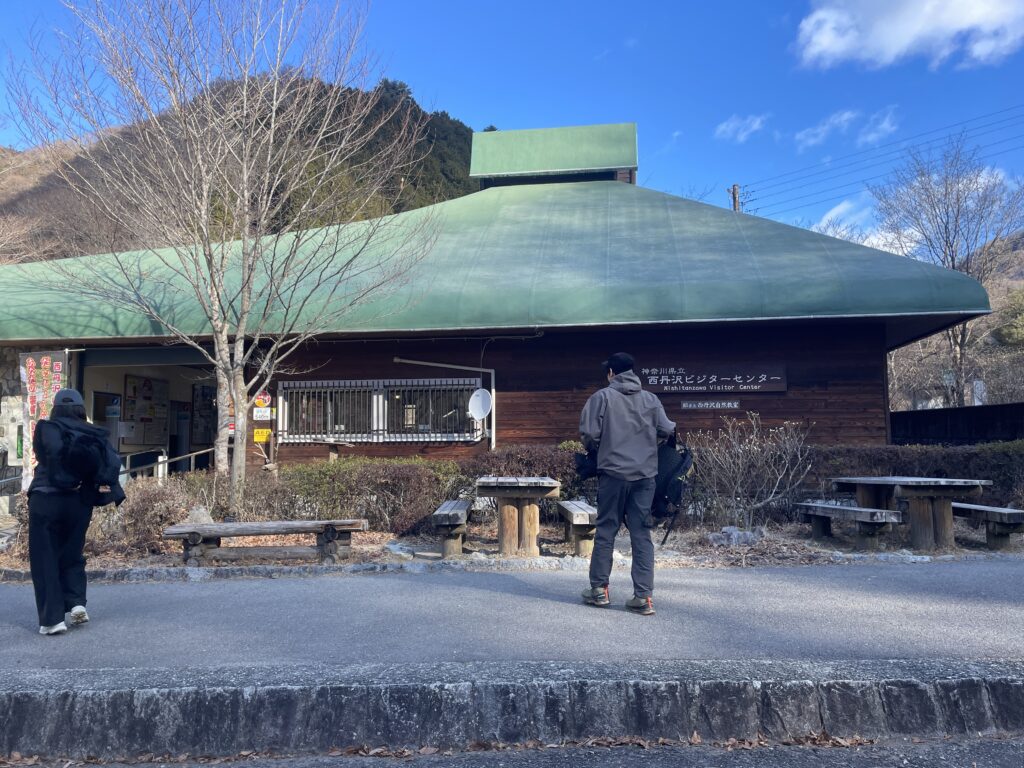
Every hike begins with a blend of anticipation and a touch of nervous energy. Today, my base camp for the ascent to Azegamaru is the Nishi-Tanzawa Visitor Center.
As someone who makes a living designing landscapes, the first thing that caught my eye was the building’s presence—or rather, its graceful lack of insistence. The sweeping green roof extends like wings, echoing the deep mountain ridges behind it. The wooden exterior, darkened and enriched by years of weather, doesn’t demand attention as the “main attraction.” Instead, it functions like an azumaya (traditional pavilion) or a piece of borrowed scenery within the vast garden that is the surrounding nature.
The log benches and tables set in front aren’t just rest stops—they serve as a threshold, a transitional zone between the paved road (the everyday) and the mountain trail ahead (the extraordinary).
The extensive use of natural materials—wood, stone—rather than metal or plastic allows the building’s edges to soften into the landscape. In garden design, one of the most challenging tasks is making boundaries ambiguous, allowing structures to harmonize with their backdrop. This building is a textbook example of that ideal.
In this season of bare branches piercing the sky, the delicate skeletal forms of deciduous trees cast soft shadows across the structure.
“What kind of natural artistry awaits me today?”
I adjusted my gear and stepped forward, as if passing through a mountain gate.
2. The Trailhead Marker: Reading Time in Materials
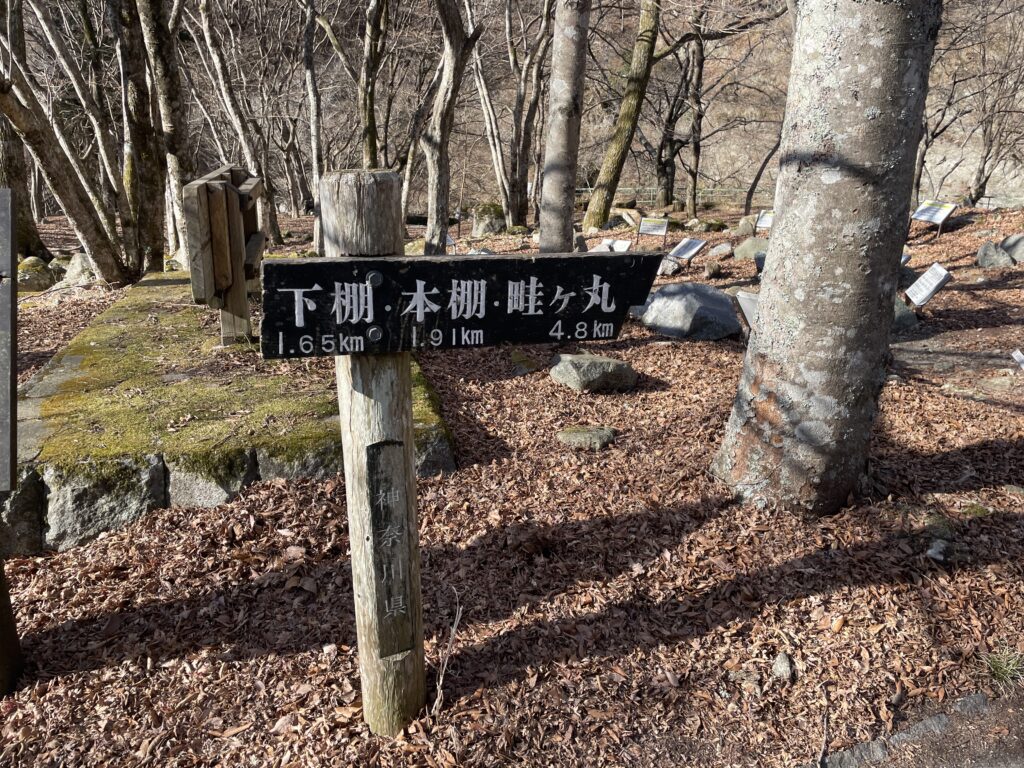
Leaving the Visitor Center behind, I stand before a trail sign pointing to “Azegamaru 4.8km.” And here my professional instincts kick in. What catches my attention isn’t the distance—it’s the marker’s post and the stone walls surrounding it.
The moss-covered stonework is evidence that humans and nature have coexisted here for generations. These old stones possess a quality of sabi—a weathered elegance cultivated by Tanzawa’s humid climate—that new stone simply cannot replicate.
Then there’s the thick layer of fallen leaves blanketing the ground. In garden terms, this is mulching—a protective layer that shelters the soil and nurtures the next generation of life. The crisp rustling underfoot creates a pleasant rhythm, a gentle prelude to the steep climb ahead.
More than the number “4.8km,” it’s this sense of accumulated time that nudges me forward. I take my first step.
3. Observing Nature’s Stone Composition: The Stream of Azegamaru
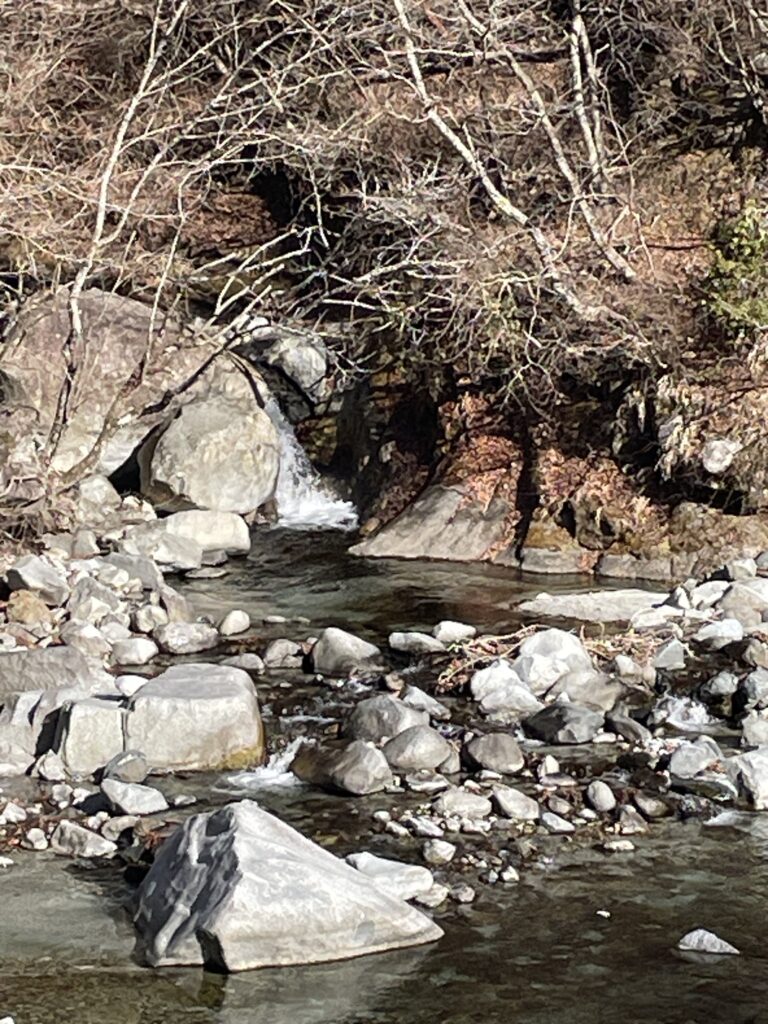
As I continue along the trail, a stream appears—a veritable exhibition hall of natural stone arrangement.
The first thing that commands attention is a massive boulder seated prominently in the center, like a takizoe-ishi (a rock placed beside a waterfall). It meets the current head-on, sending up white spray. The placement is more powerful and more economical than most garden waterfall compositions I’ve seen.
Looking at the water flowing in the foreground, I notice stones of various sizes arranged seemingly at random—yet each sits with undeniable purpose.
When we create water features in gardens, the greatest challenge is always “how to erase intention.” These stones, positioned by the sheer force of floods over time, represent the ultimate design blueprint.
Beneath the crystal-clear surface, fine gravel tells the story of the current’s rhythm. This intricate layering of texture is what gives a landscape overwhelming realism.
4. Cliff and Riverbed: The Interplay of Vertical and Horizontal
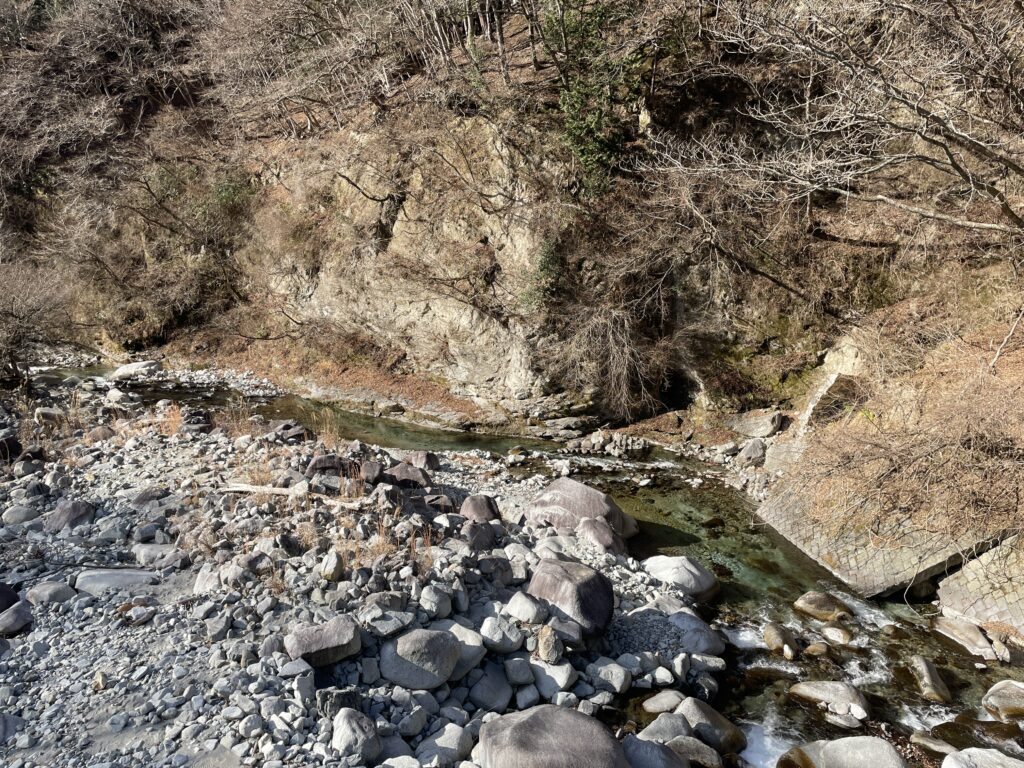
Following the stream, the view suddenly opens up to reveal a breathtaking natural “wall fountain” (hekisen) on a grand scale.
From a landscape architect’s perspective, this scene is a masterclass in contrast—a fundamental principle of garden design.
On the right, a sheer cliff rises. Exposed rock face, trees clinging tenaciously with powerful roots—this raw vertical line brings tension and dignity to the space.
In contrast, the riverbed spreads horizontally at my feet, a layered composition of stones large and small. Where the cliff conveys drama, the riverbed offers stability and expanse.
In the lower right corner of the scene, artificial retaining blocks are integrated into the natural setting. In landscape design, balancing disaster prevention and aesthetics is always a significant challenge. Over time, as soil accumulates between the stones and vegetation takes root, these rigid human-made lines will gradually soften, approaching something closer to nature’s own geometry.
Emerald-green water threads its way between the jagged stones. This coexistence of stillness (the cliff) and motion (the flowing water) is a spatial composition I want to etch deeply into my memory—inspiration for when I one day design a large-scale garden.
5. Appreciating Winter’s Branching: Mitsumata Buds Against a Cedar Backdrop
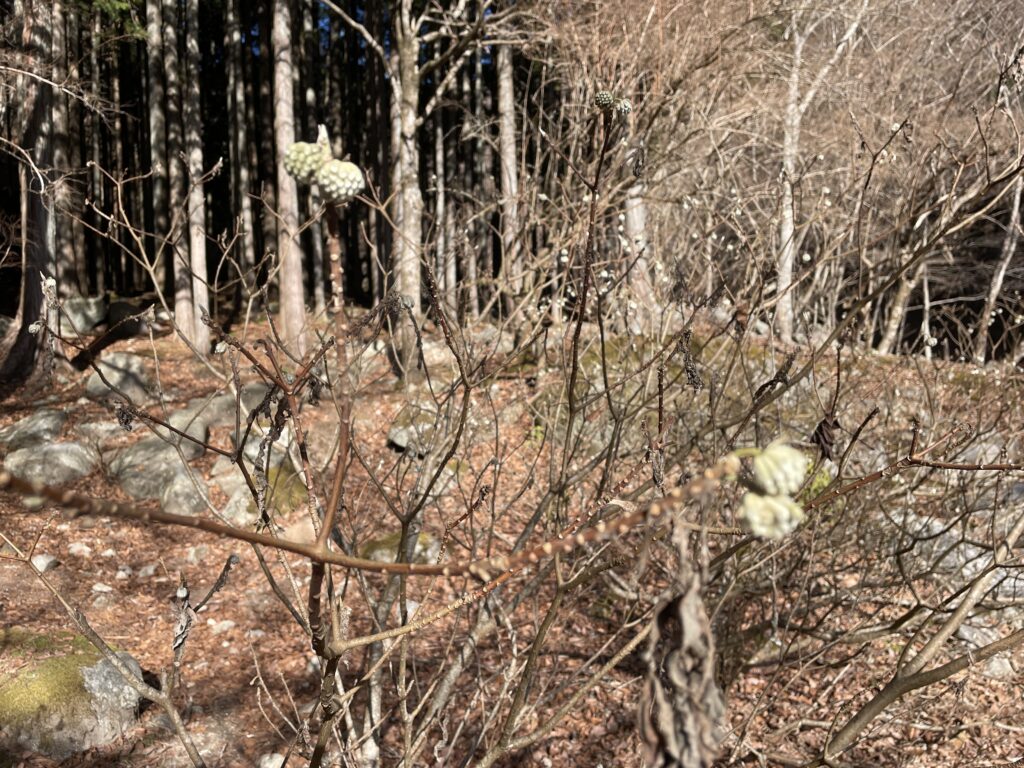
Further along, I encounter a scene unique to this season: the buds of mitsumata (Edgeworthia chrysantha), waiting for spring’s arrival.
From a landscape architect’s viewpoint, this shot reveals a carefully calibrated layering structure:
In sharp focus at the front, mitsumata branches. Their distinctive tri-forked form makes them prized specimens in garden planting. The velvety texture of the buds adds a soft accent to the dry winter air.
In the middle distance, pale deciduous branches overlap, lending depth and transparency to the space.
In the background, a stand of straight cedars. These vertical lines tighten the composition, acting as borrowed scenery that makes the free-flowing branches in the foreground stand out even more.
In garden design, placing dark evergreens in the background and lighter-colored branches or flowers in the foreground is a fundamental technique for making subjects pop. This is nature’s perfect demonstration of that principle.
6. Stone and Water in Motion: The Log Bridge and Natural Revetment
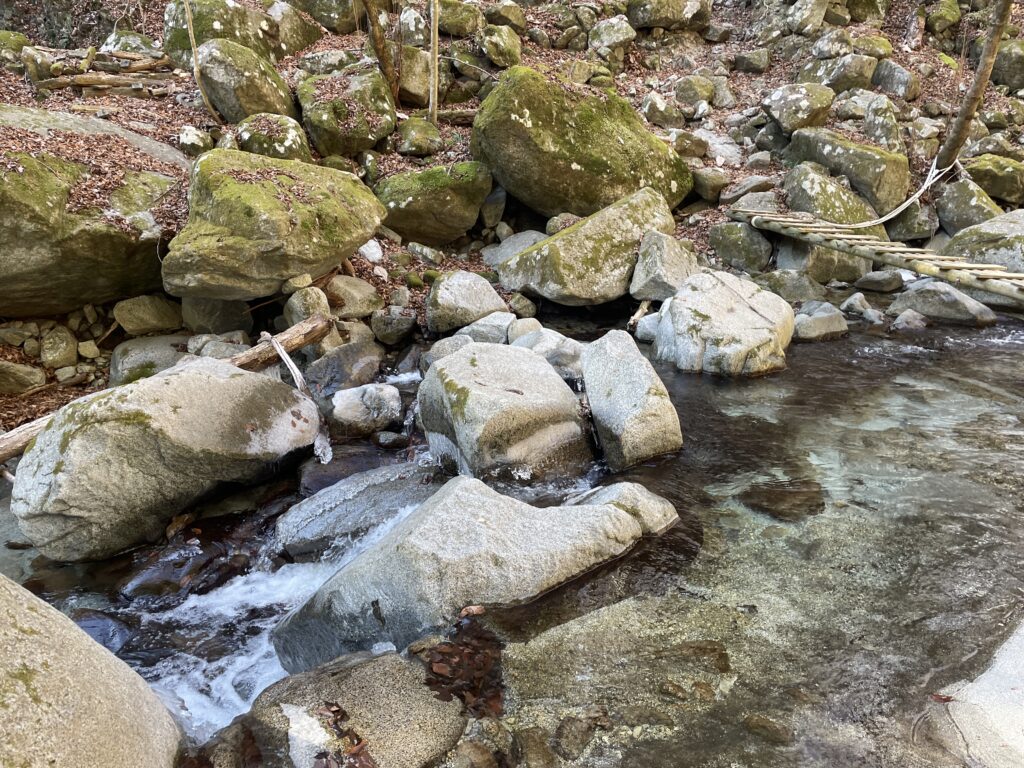
Continuing upstream, I come to a simple log bridge stretched across large boulders nestled in the stream.
From a landscape architect’s perspective, this isn’t just a “path”—it’s a tenseki (ornamental element) with functional beauty woven into the spatial composition.
Look at the massive moss-covered boulder on the left. A stone this large sits rooted to the earth with tremendous presence. When we set景石 (keiseki, feature stones) in gardens, we strive for exactly this kind of weight and stability.
Rugged, angular dry rocks contrast sharply with the smooth, water-polished stones submerged in the stream. This interplay of dry and wet, static (massive boulders) and dynamic (driftwood, flowing water) gives the landscape overwhelming realism and rhythm.
The bridge itself is minimal—just a rope handrail strung alongside the log. Yet this single slender horizontal line enhances the sense of scale, making the surrounding boulders appear even more monumental.
The water’s clarity is stunning; every grain of gravel on the bottom is visible, like a araidashi (exposed aggregate) finish. This space, cleaned and arranged by nature over decades or centuries, is the ultimate reference garden for any landscape designer.
7. Light Through Beech Forest: Depth in the Deep Mountains
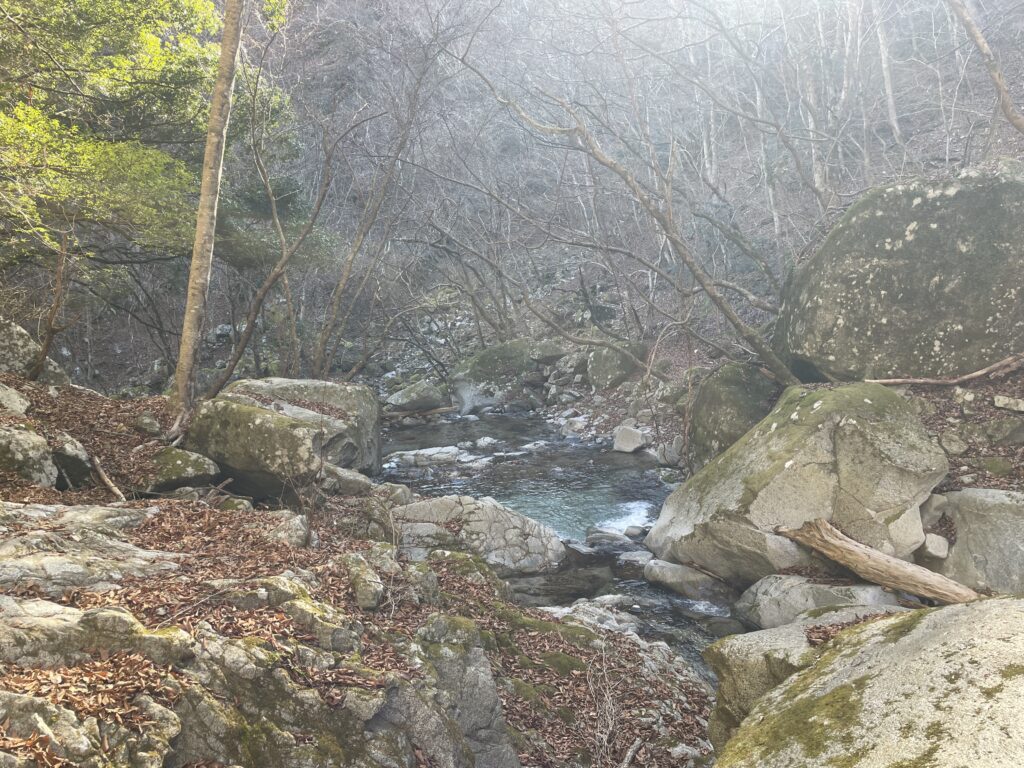
Leaving the stream behind, the trail pushes deeper into the mountains. Here, what strikes me is the “natural spatial composition” created by the overhead canopy and terrain.
Let me decode the depth of this forest from a landscape architect’s perspective.
Backlight streams in from deep within, illuminating the bare winter branches and bathing the forest in an almost divine transparency. In garden design, we create depth by contrasting a sunlit area in the distance (light) with shadow in the foreground (dark). This forest is the ideal embodiment of that technique. This “depth of light” heightens the hiker’s sense of anticipation.
On the right side of the frame, a moss-covered boulder sits heavily. It functions as an “eye-stop”—a visual anchor—tightening the composition. The contrast between this massive stone and the slender trunks surrounding it amplifies the boulder’s monumentality and creates a comforting sense of being cradled by the mountain.
The thick carpet of fallen leaves underfoot isn’t just “ground”—it accumulates along the contours, visualizing the undulations of the terrain.
The quiet stillness of this forest seems ready to dissolve into mist at any moment. The unpretentious posture of these trees reminds me, as a garden designer, of my first principles.
8. Fallen Trees Drawing Lines: Nature’s Selection
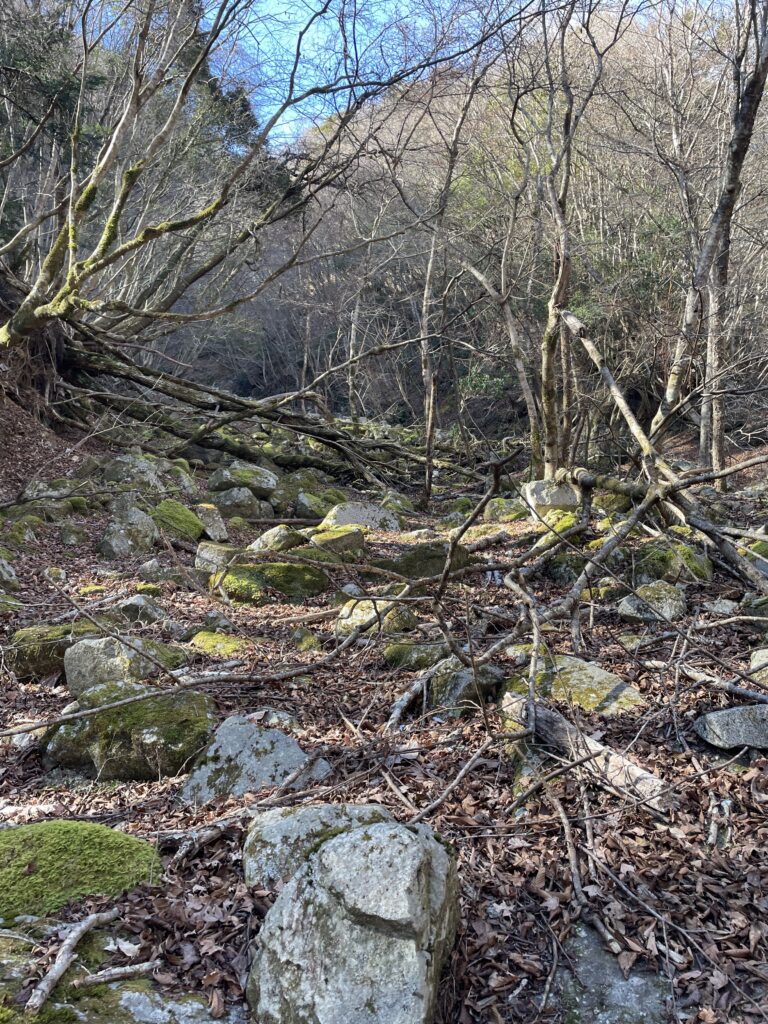
Climbing higher, the streambed becomes more rugged, yet more artistic. What catches my eye here is a dynamic scene of countless fallen trees crisscrossing in complex patterns.
Trees tumbled from the slope, overlapping one another. The sharp lines and curves they draw convey a silent energy—a mingling of death and regeneration—that no calculated garden plan can replicate. When we prune branches in gardens, we think carefully about how to create “beautiful space,” but here, nature itself is restructuring the space.
The stones sleeping beneath the deadfall are cloaked in deep green moss, creating vivid contrast with the thick layer of brown leaves.
The sight of broken branches and decaying trunks returning to the earth is the primal landscape of wabi-sabi. Gardens sometimes incorporate driftwood or weathered timber, but how to express the raw authenticity of this place—that’s where a professional’s skill is tested.
It looks chaotic, but in reality, it’s a place where the history of trees reaching for light has accumulated. This coexistence of “natural order and chaos” is like a living sculpture, revealing completely different expressions from every angle.
9. Cutting Through the Cliff: The Functional Beauty of Stone Steps in Nozurazumi Style
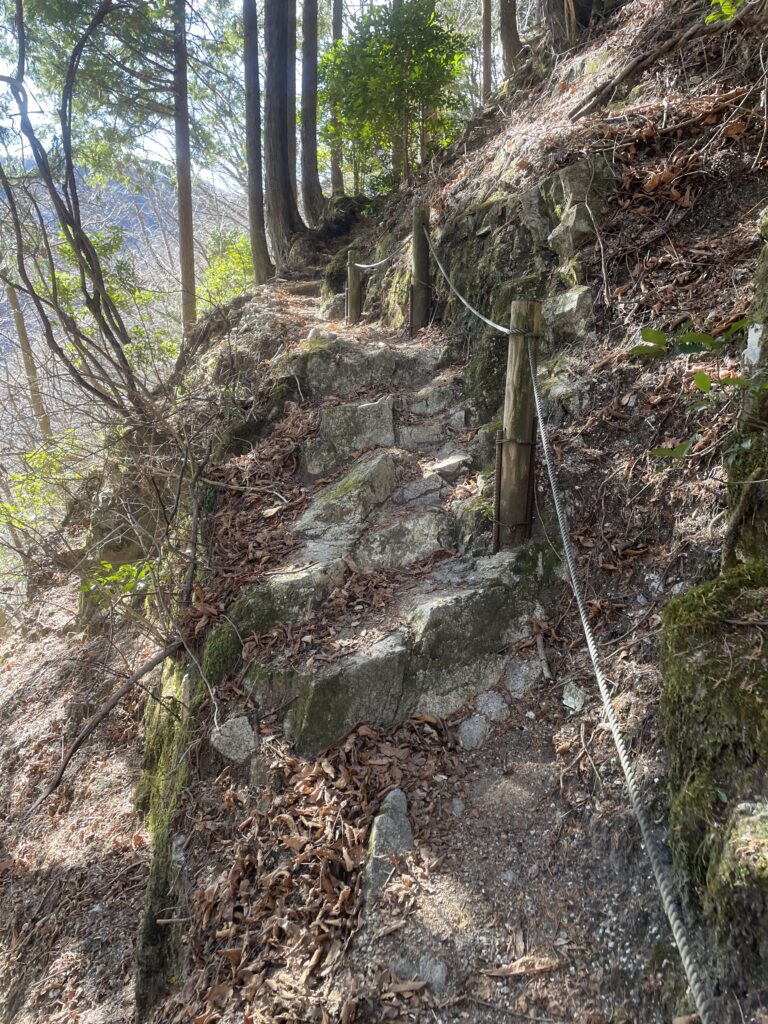
The trail grows steeper, cutting through what looks like a hewn rock wall—a precipitous section.
Looking closely at the stone steps underfoot, I realize that while they appear haphazard, they actually employ a technique similar to nozurazumi (natural stone stacking). Flat surfaces of large natural rocks are used as treads, with gaps filled and stabilized by smaller stones. Rather than forcing a level surface, the design follows the natural contours of the rock, harmonizing beautifully with the surrounding cliff face.
Moss blankets the slope on the right, and fallen leaves fill the gaps between stones. This isn’t just scenery—it’s a natural retaining wall, where plant roots and stones interlock to prevent soil erosion during rains. In garden design, how to handle slopes naturally while maintaining structural integrity is a major challenge. This is the ideal solution.
Looking up, dappled sunlight accentuates the texture of the stone steps, simultaneously conveying both the difficulty and beauty of the path ahead.
10. Borrowed Scenery and Transparency: Winter’s Spatial Composition Through Deciduous Trees
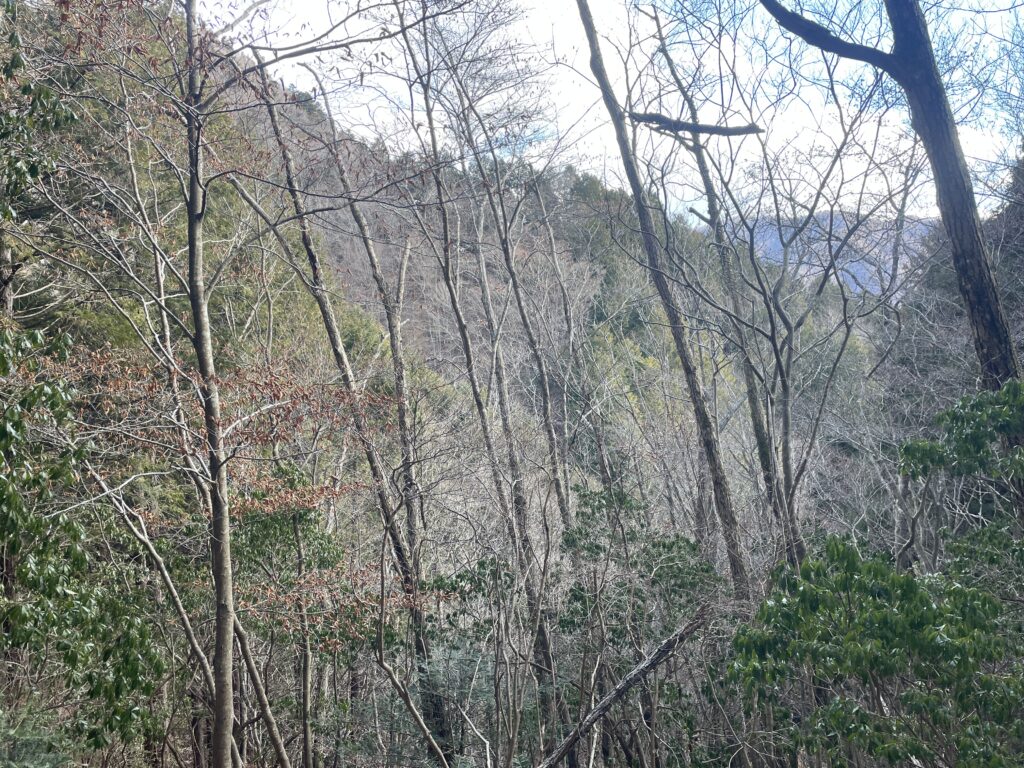
Cresting the stone steps, I lift my gaze to find the quintessential winter landscape of Tanzawa—a “transparent forest.”
The delicate tips of bare deciduous branches. In summer, these trees form a dense green wall, but in winter, the forest transforms into a “permeable screen” that allows views all the way to distant ridgelines. In garden design, there’s a technique called sukashi (screening)—not completely blocking the view, but allowing glimpses of scenery beyond through gaps in branches. This forest is nature’s perfect version of that technique. The mountain slope in the distance appears as if seen through a fine lace curtain, creating a sense of layered depth.
Evergreens as Compositional Anchors
Amid the pale deciduous branches, occasional dark green masses of asebi (Japanese andromeda) or conifers are scattered throughout. These “punctuations of evergreen” serve as visual anchors, preventing the pale winter landscape from feeling too sparse. The secret to keeping a winter garden from feeling desolate lies in the strategic placement of evergreens—and that principle is perfectly demonstrated here.
Vertical Lines Creating Rhythm
Countless slender trunks rise vertically, overlapping to create a rhythmic pattern. Individually they may seem fragile, but collectively they give the space undeniable “density” and “structure.”
In the cold, crisp air, distant ridgelines (borrowed scenery) are framed by nearby branches (foreground). This is the “subtractive beauty” of negative space—an aesthetic unique to this season.
11. Breathing Steps: Holding Soil, Letting Wind Pass
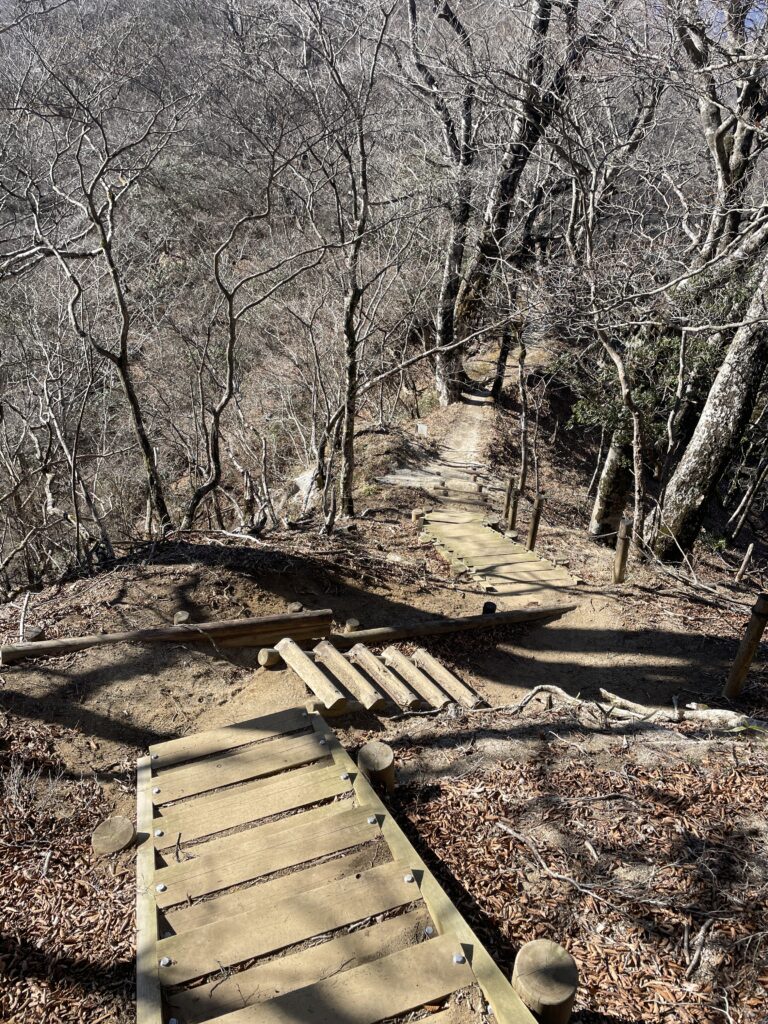
The stairway in the foreground appears recently rebuilt. Bolts secure it firmly, and anti-slip measures are visible on the treads. But this isn’t merely “for easier walking.” On steep slopes, human footsteps churn the soil, and rainwater follows those grooves, washing earth away. These steps function as “artificial roots”—a bulwark holding back soil erosion and maintaining the mountain’s structural integrity.
In the middle ground, weathered log retaining walls have settled into the terrain. The mix of fresh timber and old wood grayed by wind and rain reveals that this trail has been “protected through repeated repair.” By using materials that decay, humans lend a hand at a pace matching the mountain’s own regenerative rhythms. This layering of timescales creates the depth in this landscape.
12. Light and Snow Drawing the Ridgeline Boundary
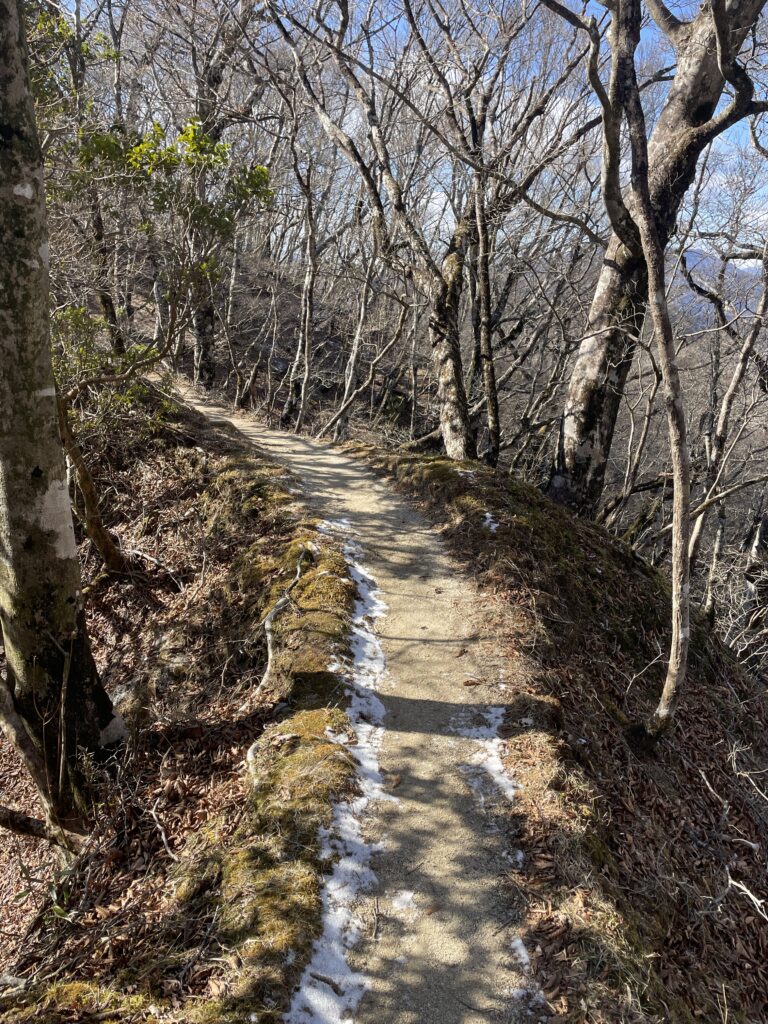
On this open ridge path, I find a dramatic spatial composition where the remnants of harsh winter meet the promise of spring. Through a landscape architect’s lens, this single frame conceals a beautiful harmony of circulation and texture.
The path gently curves leftward through the center of the frame. Using a curve rather than a straight line naturally draws the eye deeper into the scene, making the expanse of the mountain feel larger. This “hidden continuation” is exactly how stroll gardens build anticipation for the next view.
Patches of white snow lingering in shade, deep green moss covering the slope, and brown fallen leaves blanketing everything else. This three-color contrast brings vibrant rhythm to an otherwise monochrome winter path. The way the snow sits in scattered patches—like variegation—makes the micro-topography and surface undulations stand out in three dimensions.
Bare trunks rise from both sides. These vertical lines bring order to the space. Because the trees are leafless, the sky glimpsed between trunks creates “openings,” amplifying the sense of elevation and liberation that comes with approaching the summit.
The soft texture of earth underfoot, the cold, clear air. This “natural garden path,” swept and arranged by nature over long stretches of time, possesses a serene beauty that makes walking itself feel meditative.
13. Function Meets Scenery: Azegamaru Emergency Shelter
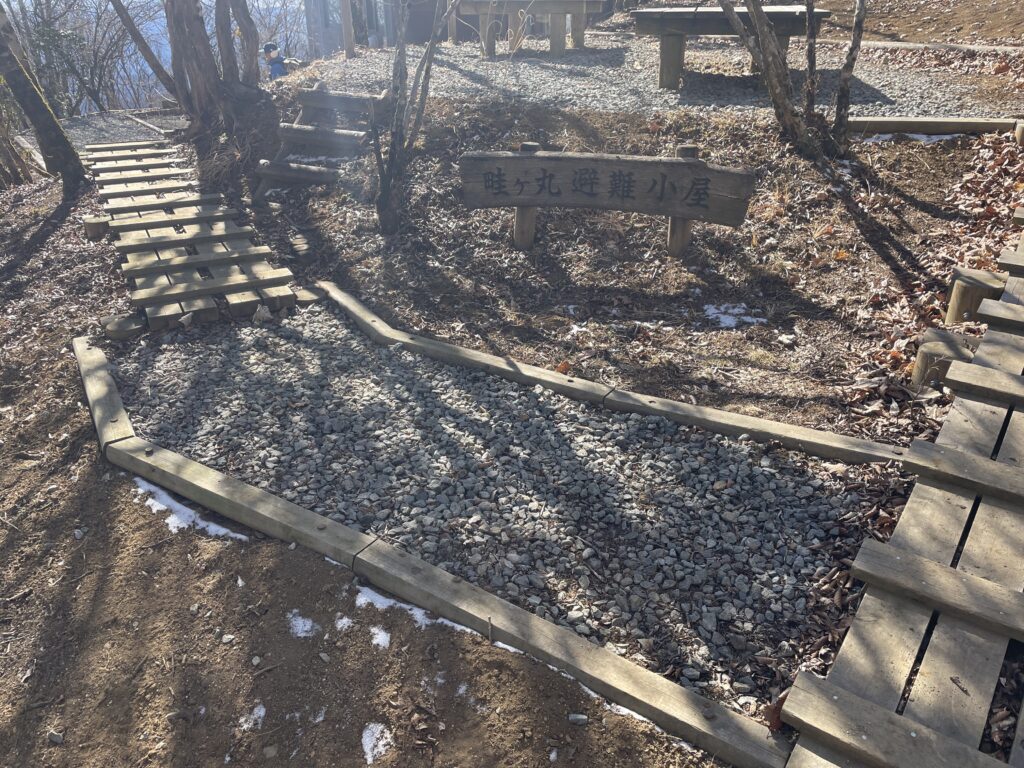
Near the summit, a clearing opens up around the emergency shelter. Here, I’m interested in how human “design” and natural topography have reached an accord—the rationality of this spatial planning.
A gravel-covered space spreads out in front. Wooden edging defines the boundary, preventing soil erosion while ensuring easy walking. Gravel—a material whose texture is similar to the surrounding mountain stone—strikes an excellent balance: functional yet unobtrusive, not jarring against the landscape.
A wooden walkway extends toward the back left. The evenly spaced slats create rhythm on what would otherwise be monotonous ground. The stairs that handle the elevation change aren’t carved aggressively into the slope but follow its natural contour—a clear example of the landscape design principle of “conforming to topography.”
Signs, benches, walkway—all are unified by weathered, gray-toned wood. This material consistency resonates beautifully with the austere color palette of the winter forest. By minimizing intervention and allowing the surrounding trees (borrowed scenery) to remain the protagonists, this design serves as a textbook example of creating a mountain clearing.
Long shadows fall across the gravel, cast by filtered light—a quiet testament to the high elevation. In the midst of harshness, there’s a gentleness here, a “garden-like” quality shaped by human hands.
14. Framed Borrowed Scenery and Tranquil Interior
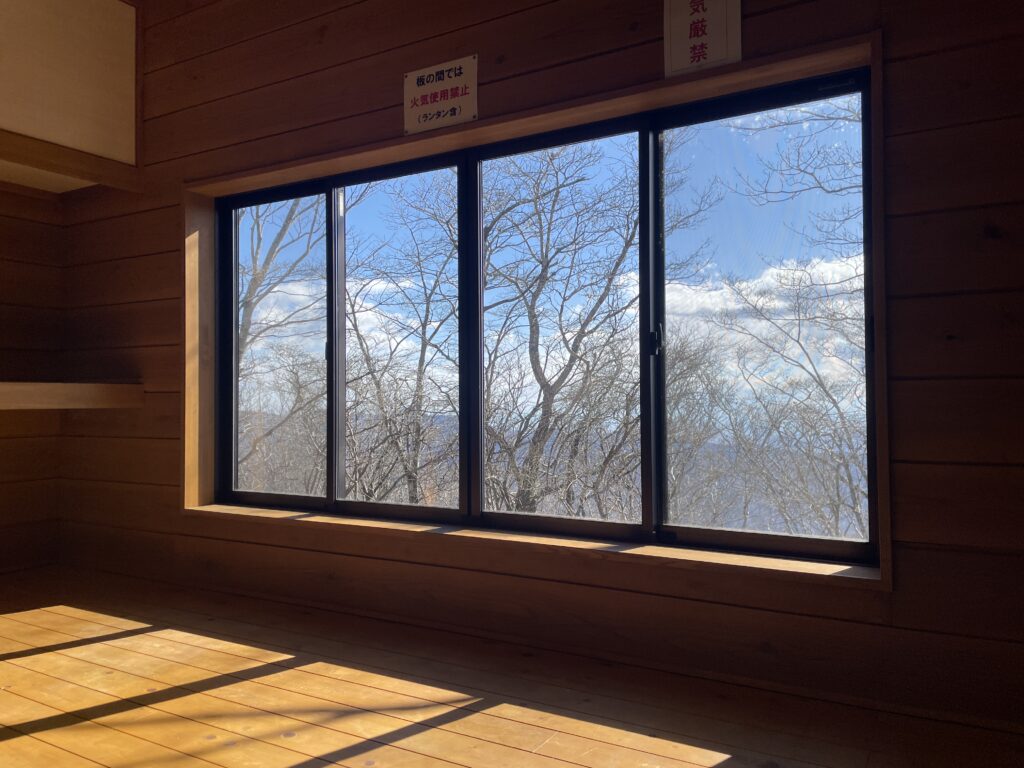
Stepping inside the shelter, I’m greeted by a moment where architecture and nature intersect most beautifully. As a landscape architect, I’m deeply moved by the “framed garden” composition created by these windows.
Three large windows frame the winter-bare trees and blue sky like a triptych altarpiece. Rather than making the entire wall glass, the substantial wooden frames divide the view into sections, creating rhythm and structure. This transforms mere observation into something approaching art—adding layers of aesthetic depth.
Intense winter sunlight slants across the bare wooden floor. These bands of light become a “dynamic” design element within the static interior. The deep wood texture of the walls (shadow) and the piercing brightness outside the windows (light) create a powerful contrast—a serene quality reminiscent of a Zen garden, inviting contemplation and calm.
Beyond the glass: intricately crossing bare branches, ridgelines beyond, and the endless winter sky. Unlike the soft light filtered through shoji screens, the stark winter details burst through the glass directly, creating vivid contrast with the warm, wood-filled interior.
Inside an artificial shelter, yet so intimately and beautifully framing nature’s presence. This is where architecture and landscape design dissolve into one—a highlight worthy of this mountain journey.
15. Summit Self-Portrait: The Design of Achievement

Finally arriving at Azegamaru Emergency Shelter, I take a photo.
16. The Bitter Cold Told by an Ornament

An old thermometer hangs on the shelter wall. In landscape design, we call small objects that add narrative to a space tenseki (ornamental accents). This thermometer eloquently tells the story of “the mountain’s face today.”
Look closely at the thermometer’s wooden mount. Exposed to wind and rain, its oils leached away, it has faded to a pale “silver-gray.” In landscape design, this is one of the most beautiful states—when natural wood fences or decks age over years and blend seamlessly into their surroundings. We’re witnessing the process of natural materials returning to become part of nature itself.
The blue and yellow caps used to secure the thermometer. In the stark, utilitarian context of the mountain trail and shelter, these small splashes of primary color convey something else—a warmth, a touch of playfulness from those who maintain this place. When such “off-notes” appear within perfected beauty, they make a space feel approachable, human.
17. Journey’s End: The Green Amphitheater
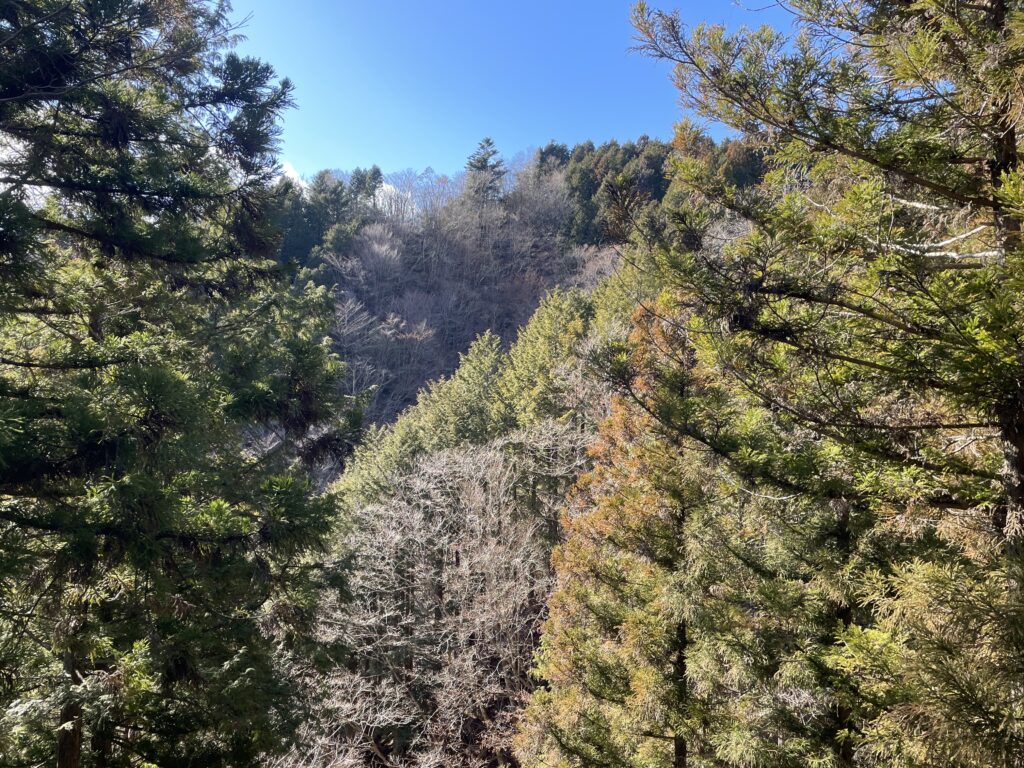
On the descent, I glance back, and this view captures the most vivid contrast between evergreen and deciduous that winter Tanzawa has to offer. Through a landscape architect’s eyes, this is nature’s grand “theater structure.”
Evergreen conifers jut out from left and right, forming a large V-shaped frame toward the center. This inevitably draws the eye into the valley, emphasizing the forest’s depth and the terrain’s undulation. By intentionally narrowing the view, interest in what lies beyond is heightened—this is the technique of inken (reveal and conceal) executed at a monumental scale.
Heavy, weighty evergreens (deep green) mix with deciduous branches that shimmer translucently in winter light (silvery white). This patchwork of contrasting textures is the ultimate model for winter garden planting design. The diversity that a single species cannot provide is abundantly present on this slope.
Deep in the valley, a section glows white, reflecting light. Contrasted against the dark evergreens in the foreground, it appears like a stage bathed in spotlight. In winter mountain hiking, finding these “pools of light” is an important source of both reassurance and visual warmth.
18. Light Beams Piercing the Sacred Realm
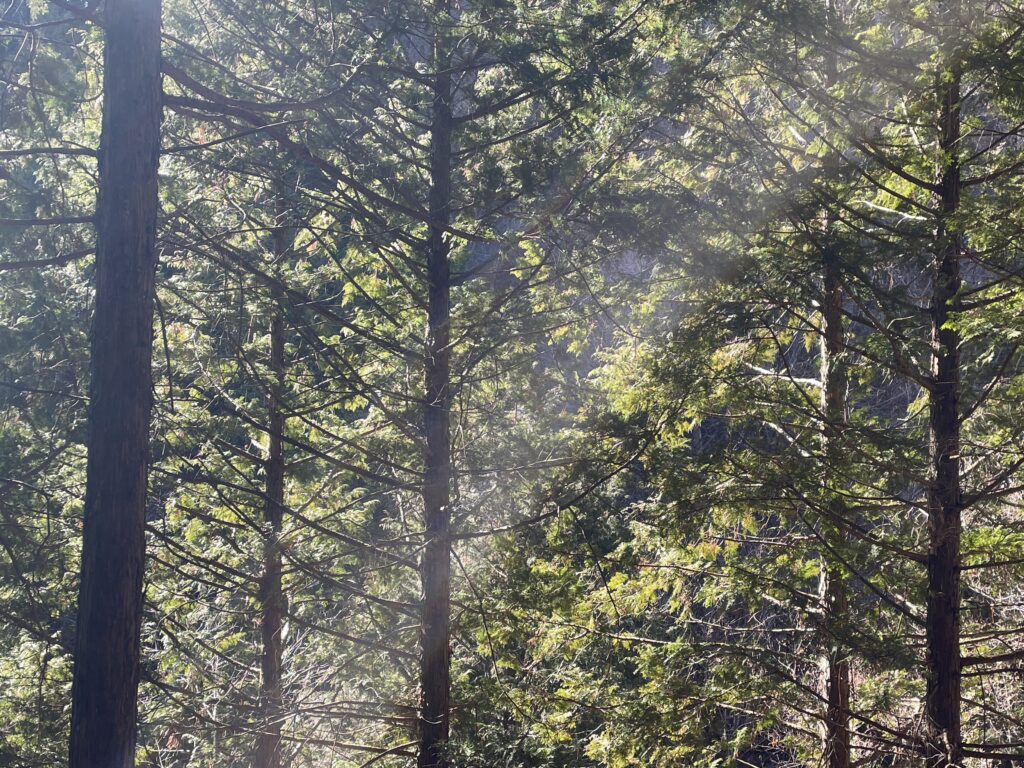
This frame is among the most transcendent of the entire journey—the pinnacle of “light design” that any landscape architect would dream of recreating.
Multiple bands of light slice diagonally through the center of the frame. These are caused by moisture and fine particles in the air catching the light, introducing “time” and “movement” into an otherwise still forest. In landscape lighting design, how to create these “shafts of light” is an eternal challenge—yet here, nature achieves it at the perfect angle.
Straight trunks of cedar (or cypress) pierce through the frame. These intense vertical lines, evenly spaced, resemble the columns of a temple. This regularity brings discipline and tranquility to the space, signaling to the viewer: “Beyond here is a special place.”
Facing the sun head-on in a backlit composition, every leaf and tree edge glows with a fine rim of light. This gives the trees not the quality of background elements, but of luminous beings radiating their own life force—creating dimension and vitality.
From the dark forest floor, I gaze up at a dazzling shower of light. Without artifice, using only “light and shadow” to dominate the space. The ultimate goal of landscape design—”peace of mind”—is distilled in this single natural scene.
19. Natural Green Wall on a Vertical Canvas
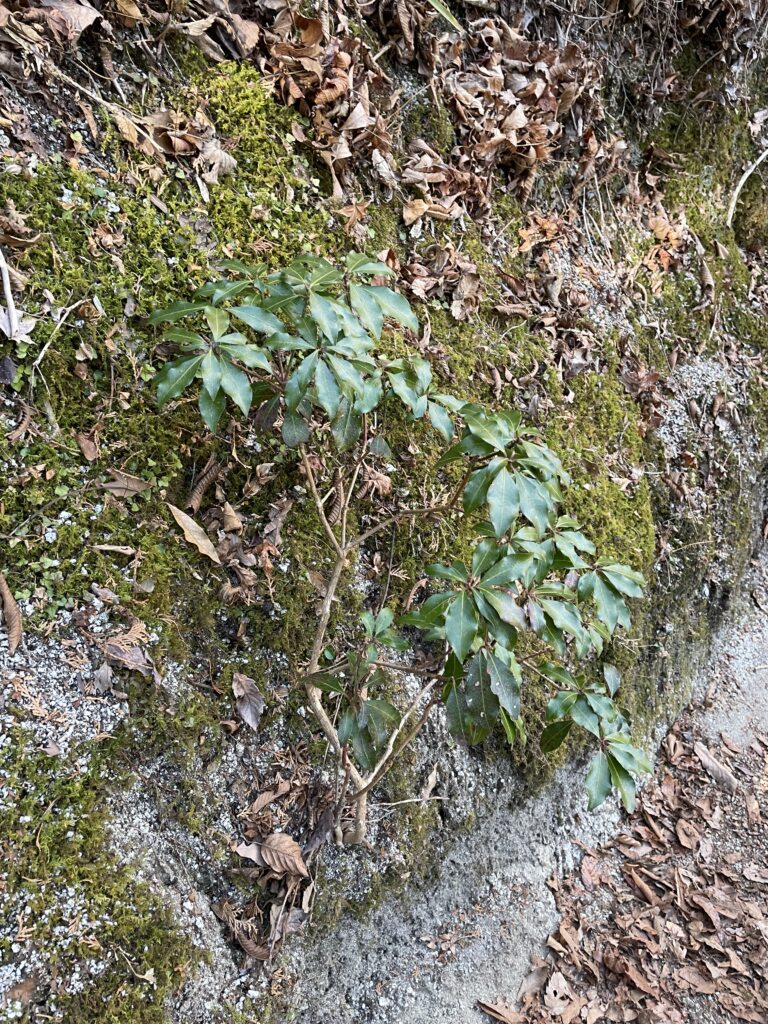
Looking up from the trail, I see a steep slope. Clinging to this harsh environment are low shrubs—a powerful testament to life’s tenacity.
The sheer rock face is covered in moss, with fallen leaves accumulated on top, creating a natural gradient. In gardens, artificial “green walls” are notoriously difficult to maintain, but here, moisture-rich moss forms the foundation, creating the perfect microclimate for plants to root.
Evergreen shrubs like asebi stand out as glossy “patches of deep green” against the winter’s austere palette. Scattered around them, the “brown fallen leaves” of maple and beech add colorful accents (points) to what might otherwise be a monotonous wall.
Not everything is smothered in green—rough rock texture is exposed in places. This contrast between “civil strength” (stone) and “plant softness” is what gives mountain landscapes their unique tension and beauty. This is the origin point of what we call “harmony between stone composition and planting” in garden design.
At first glance, it’s just a rugged cliff. But closer observation reveals optimal placement according to water flow and light conditions. Nature has been “maintaining” this space over vast stretches of time—the ultimate living wall garden.
20. Weaving Time: The Moss-Covered Stone Composition
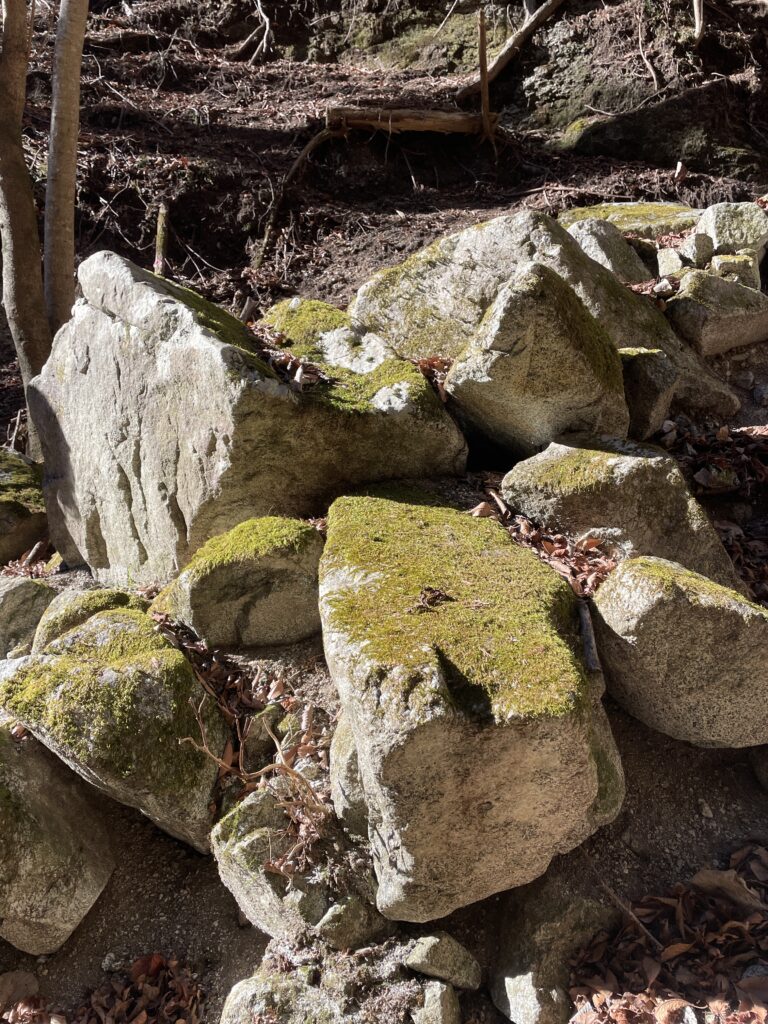
A casual pile of stones, yet undeniably powerful. Through a landscape architect’s eyes, this corner is the pinnacle of ishigumi (stone arrangement)—nature’s completion over eons.
A flat, central boulder anchored by stones of differing character on either side—this configuration evokes the stability of sanzon-ishigumi (three-stone compositions) in Japanese gardens. Precisely because there’s no human intention, each stone has settled into the place where it most naturally belongs—a harmony only nature can achieve.
Vivid green moss draped beautifully across the stone’s upper surface. This “natural makeup” appears only where sunlight and humidity conditions align perfectly. The contrast between cold, hard rock and soft, warm moss gives this static mass a fresh, “living” expression.
Rather than sitting fully exposed, the stone’s lower portion is deeply embedded in soil and leaves (good root anchoring). This makes the viewer imagine the unseen mass and weight below. This sense of “growing from the earth” is what gives gardens depth and history.
Soft winter light illuminates the moss’s granular texture while carving deep shadows into the stone. A mere pile of rock, transformed by light and moss into something that seems to speak.
21. Spotlight Through the Canopy: Untouched Green
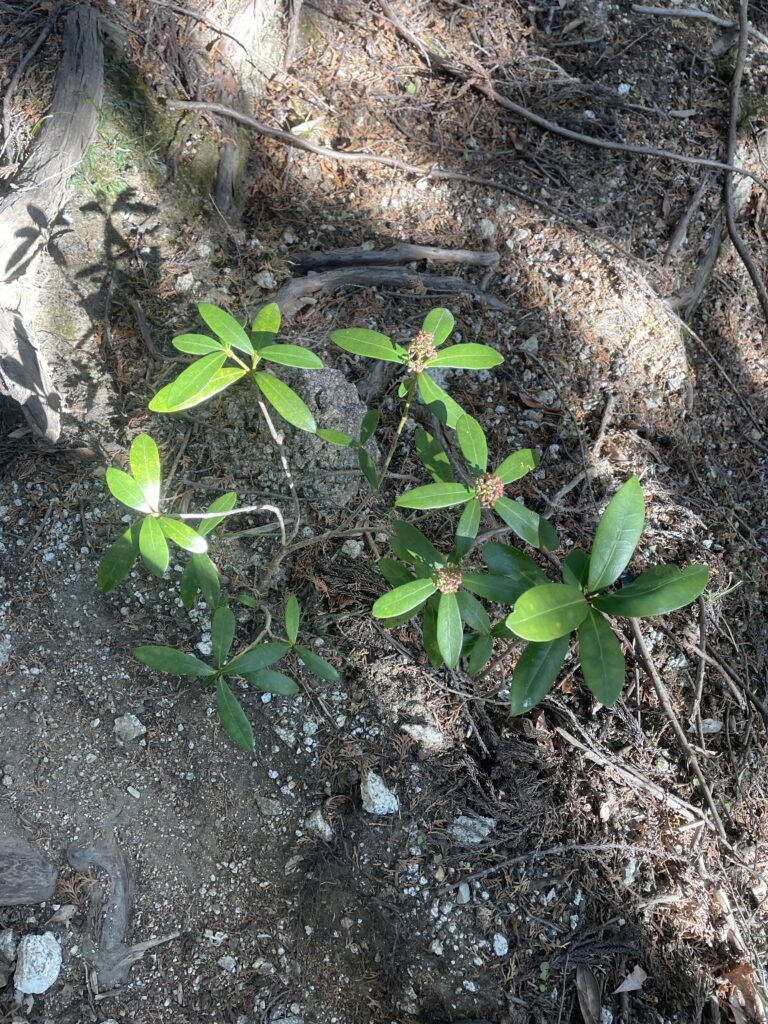
Partway down the trail, a low shrub quietly but resolutely spreads its leaves across dry earth. Through a landscape architect’s lens, a brilliant “spotlight effect” is at work here—nature’s stage direction.
The surrounding ground is covered in cedar branches and dark soil, yet this single plant is bathed in direct sunlight from above. This “contrast of light and dark” intensifies the lush texture of its evergreen leaves, making it float above the space like an actor caught in a spotlight on a dark stage.
Perhaps miyama-shikimi (Japanese skimmia)? The leaves unfurl radially from the center in perfect balance. This “circular form” brings exceptional visual stability (structural beauty) to an otherwise chaotic forest floor.
My own shadow stretching to the upper left, the long shadows of surrounding dead branches. These “shadow lines” run diagonally, adding the dynamic dimension of solar movement—a temporal axis—to an otherwise static plant.
Not “merely growing there,” but “chosen” by this fleeting moment of light. In the harshness of winter, this plant conserves soil heat and desperately gathers light efficiently—a blueprint of life’s design distilled in this single frame.
22. The Water Corridor of Silence and Moss Territory
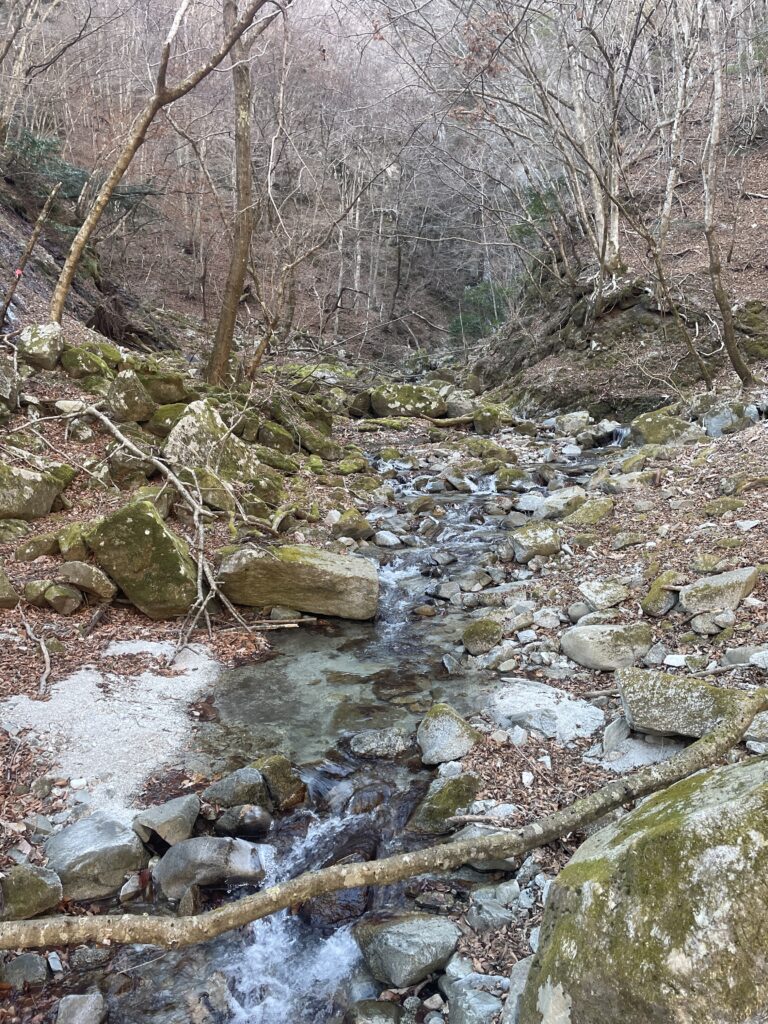
On the descent, the stream becomes the protagonist once more. Through a landscape architect’s eyes, this is the ultimate expression of “flowing water” design—crafted over unimaginable spans of time.
Crystal-clear water meanders through the center of the frame. The line of water—from shallow foreground to deeper background—visually conveys both “movement” and “coolness.” When creating water features in gardens, the most essential reference is this natural rhythm of branching and merging born from irregular stone placement.
Massive moss-covered boulders anchor both banks of the stream. These aren’t just rocks—they carry the dignity of natural retaining walls, stabilizing the ground. Against the background of winter’s muted tones, the “vivid green moss” concentrated at the water’s edge emphasizes that this is a special corridor of life sustained by water.
A single fallen tree boldly crosses the foreground. By adding this horizontal line (ichimonji) to the frame, it momentarily arrests the downward flow of the stream, creating exquisite “pause” and depth. An unintentional fallen tree here functions like a kekkai (boundary marker), partitioning the space.
Water clarity, boulder monumentality, quiet air threading through deadwood. Everything harmonizes into a pristine “water garden” that cleanses the walker’s spirit.
23. Ice Sculpture and the Boundary Between Motion and Stillness
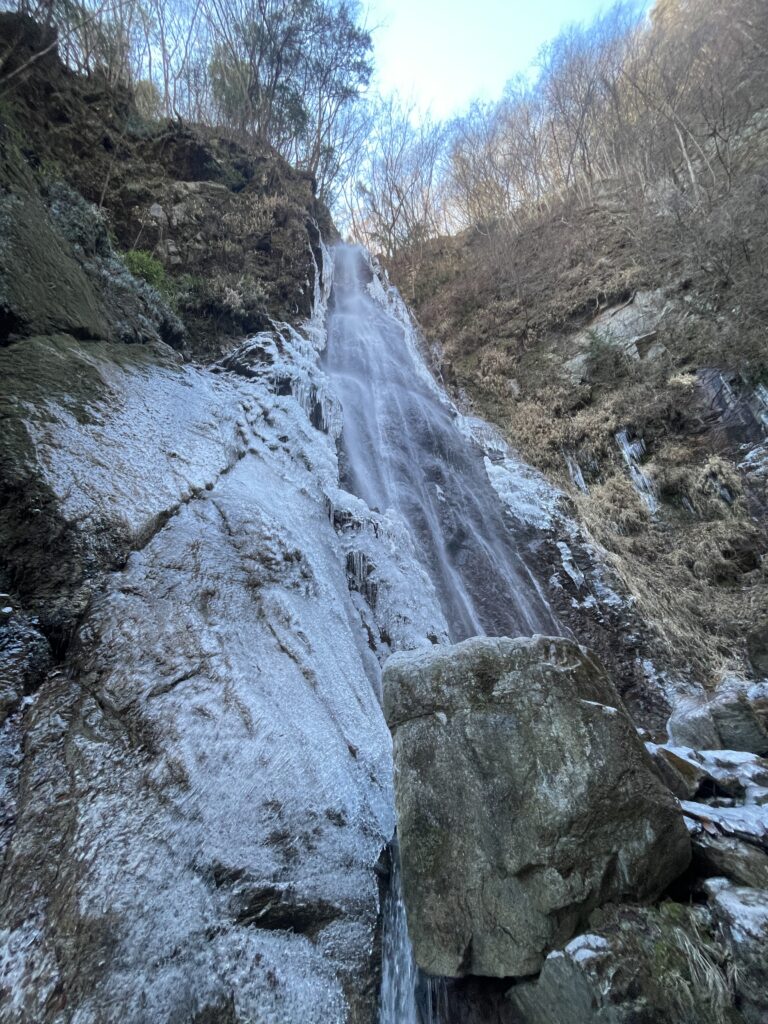
Near the end of the descent, I finally reach this waterfall. Here, a miraculous space exists where spray frozen mid-motion (stillness) coexists with water still cascading (dynamism).
Thousands of icicles cloaking the rock face—like delicate lace woven by nature over time. The whiteness of this ice creates fierce contrast against the black rock, sharpening and sanctifying the waterfall’s outline.
Around the waterfall’s basin, rounded ice formations blanket the rocks. These aren’t merely products of cold—they’re transparent sculptures grown from countless overlapping layers of spray. By encasing the rocks’ irregular contours, the ice forms a smooth, otherworldly ground cover.
A pale blue glow seeps through the ice’s depths. This color—born of the ice’s thickness—brings profound silence to the space. The violent energy of falling water (motion) is quietly enveloped and restrained by surrounding ice. This “equilibrium between motion and stillness” is the essence of a winter waterfall’s unique tension.
In cold so intense it numbs the fingertips, such crystalline, pure natural artistry. Before this scene, perhaps words are unnecessary. You simply want to immerse yourself in this overwhelming “world of white and blue”—a fitting terminus for a winter journey.
24. Twilight’s Golden Finale
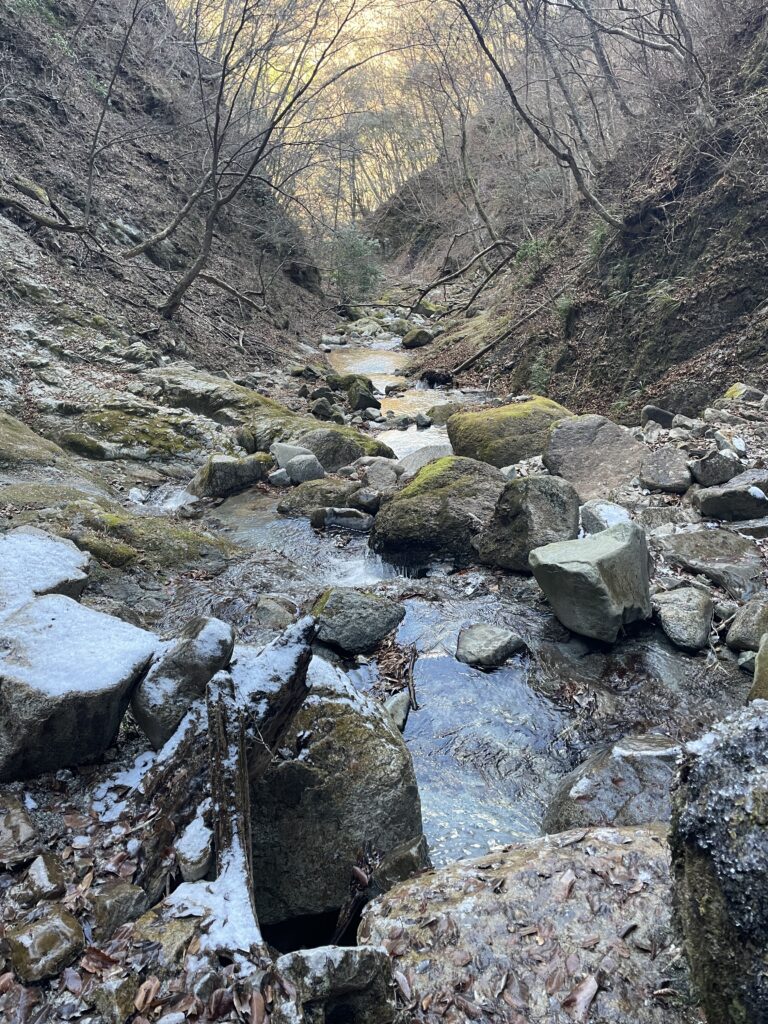
At the trail’s end, the stream meanders gently, reflecting the evening sky ahead. Here, the “depth of light” that nature creates without calculation is most pronounced.
Deep in the valley, where sky and ridgeline intermingle, everything glows gold. That light reflects onto the stream in the foreground, warming the cold water’s surface. In garden design, there’s a technique of connecting spaces by reflecting distant brightness onto water—and here it unfolds at grand scale.
On a large boulder in the foreground, white ice still clings. Beside it, deep green moss. Between the rocks, brown fallen leaves. These three colors and textures condense winter’s mountain transitions onto a single canvas. Seasonal elements layered atop immovable stone—this is true natural ishigumi.
Between slopes and boulders pressing in from both sides, water traces a gentle S through the center, heading toward the depths. This “line that appears and disappears” naturally draws the viewer’s awareness toward the glowing valley exit (the future, the return home).
After a long day—steep trails, frozen waterfalls—I arrive at this gentle light at last. It feels like the kindest “ending” that nature’s vast garden could possibly prepare.
25. Journey’s End: The Repose of a Recumbent Stone
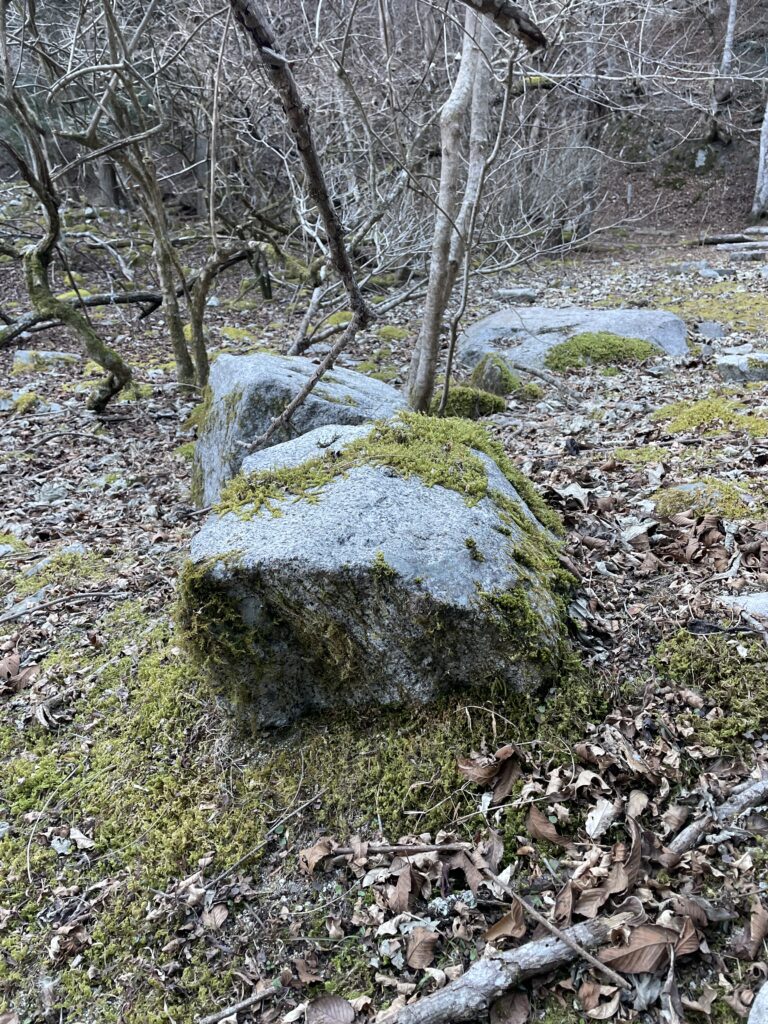
A moss-covered stone seated among fallen leaves. From a landscape architect’s perspective, this corner is the final form of perfect ishigumi—nature’s placement refined over ages.
The boulder rests low and grounded, not emphasizing height but appearing deeply rooted in the earth—the posture of a fuseishi (recumbent stone). This placement radiates overwhelming “stability” and “stillness” to the viewer. It’s a design full of calm—fitting for a journey’s end.
Vivid green moss creeps along the stone’s ridgeline. Surrounding it, the fallen leaves of oak and beech. This contrast of “green and brown” is one of the most beautiful color schemes in winter garden design. It conceals the soil and gently cradles the stone’s presence—a natural mulch.
Bare, slender trunks rise behind. The overlapping vertical lines accentuate the heavy stone mass in the foreground. The balance between “sparse (scattered branches)” and “dense (monumental stone)” elevates this roadside moment into a complete, composed “view.”
26. Resilience in the Rock Seam: The Beauty of Boundary Design
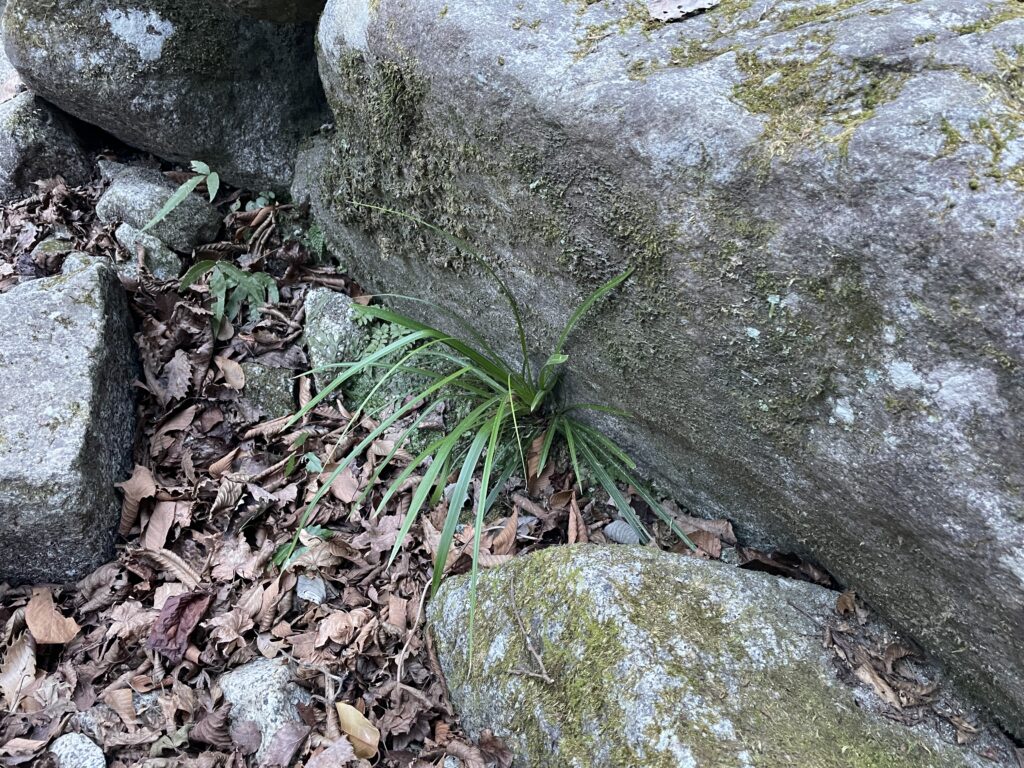
This frame is the ultimate model of “stone composition and planting” in landscape design—a distillation of plant tenacity surviving harsh nature.
From the seam between massive boulders, a plant—perhaps shunran (a type of orchid) or sedge—gracefully extends its leaves. In gardens, there’s a technique called ishiai-ue (planting in stone gaps), and this is its primal form. The contrast between hard rock and soft, slender leaves makes each quality more vivid.
At first glance, just a crack in the rock. But within, trace amounts of soil, moisture from above, and decomposed leaf nutrients have accumulated. While the surrounding ground is covered in dry leaves, this spot alone retains lush greenness because the rock acts as a shelter, protecting a micro-ecosystem.
The foreground stone wears a faint veil of moss; the larger boulder behind is patterned with complex lichen. This koshoku (antique patina) conveys that this place has stood unchanged for decades, perhaps centuries—a temporal depth that brings profound reassurance to the viewer.
Conclusion
This winter hike through Nishi-Tanzawa’s Azegamaru was also a journey to decode nature through a landscape architect’s lens. Stone compositions, trees, the interplay of light and shadow, flowing water—all perfected as nature’s garden, achieving flawless harmony without human intervention.
And finally, by placing myself within that scenery, the journey finds its completion. Standing in nature, experiencing the accumulation of time, the staging of light, the order of life. It felt like touching, with my whole body, the “origins of garden-making” that winter Tanzawa revealed to me.
What mountain will I visit next? What “natural design” will it show me? Another door to a new garden is about to open.
Ryoji Nakayama (Ecological Landscape Producer)
https://ryojigarden.com/